



Promising!

This is Berlin’s most promising spot: Water and nature close to the city center.

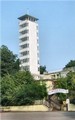
 Not only the “Müggelberg” (Müggelhill) with the well-known “Müggelturm” (Müggeltower) offers an excellent view. The “Müggelturm” (Müggeltower) is a 29,61m high and roofed building in the “Müggelberge” (Müggelhills).

 The viewing platform - 126 stairs high – was built 120m above sea level.

1 - Arena – Concert and Culture Hall

Eichenstraße 4, 12435 Berlin
U-Bahn 1 (station Schlesisches Tor), S-Bahn station Treptower Park

The “Arena” - one of the largest and most popular cultural locations of Berlin, is located in Treptow’s north, near the center and directly at the „Spree“. The ecologically redecorated monument (bus depot from 1927) is large enough for up to 7.500 guests visiting concerts, performances, exhibitions and other events. We also recommend the club- boat “Hoppetosse” and the stage “Glashaus”.

2 - Watch tower of the Berlin Wall

Schlesischer Busch/Puschkinallee, U-Bahn 1 (station Schlesisches Tor), S-Bahn station Treptower Park, busses

The only originaly existing large watch tower of the Berlin Wall was built in the heart of the former and now reconstructed recreation park „Schlesicher Busch“ at the „Landwehrkanal“ (canal) between Berlin-Treptow (former east) and Berlin-Kreuzberg (former west).
This monument reminds of the city’s longtime division.

3 - „Treptowers“ and "Molecule Man"

At the Treptowers/Hoffmannstraße, 12435 Berlin-Treptow, S-Bahn station Treptower Park

The capital’s highest office tower (125m, 30 floors) is the district’s new visible landmark, a newly developed modern city area with offices, flats, boardwalk, watercascade and the “Molecule Man”. The 30-meter-high metal sculpture by American sculptor Jonathan Borofsky, standing right in the “Spree”, is the most obvious part of a large collection of constructive and concrete art belonging to the “Allianz-Insurance-AG”.

4 - Treptower Park

Puschkinallee, Straße am Treptower Park, 12435 Berlin-Treptow, S-Bahn station Treptower Park or Plänterwald, busses

„Treptower Park“, located directly at the „Spree“, has a size of 160 ha and is Berlin’s second largest public park (the largest one is “Tiergarten”). It was designed in 1874 by former Lenné student, then Berliner and gardening director Gustav Meyer as Berlin’s “first accessible park” and actualized in 1887. With this English park and its numerous avenues, groves, meadows, flowerbeds, ponds and sculptures, Meyer fulfilled his vision of public recreation. This park offers the scenic framework for the Treptow harbor, the Soviet soldier cenotaph, the Archenhold Observatory as well as inn “Zenner” and “Abtei” (abbey) island. 

5 - Treptow Harbor

Puschkinallee 15, 12435 Berlin-Treptow, S-Bahn station Treptower Park

This updated harbor accommodates the headquarter of “Stern und Kreis Schiffahrt GmbH” as well as the moorage and place of departure for excursion boats of Berlin’s largest passenger fleet.
Located directly by the waterside, this harbor offers its guests seasonal gastronomy and many different kinds of events.

6 - Soviet Soldiers Cenotaph

Puschkinallee, 12435 Berlin-Treptow, S-Bahnstation Treptower Park, busses

The Treptow cenotaph was built with granite plates from the “Reichskanzlei” (imperior chancellor) in 1946–48 as commemoration and cemetery for soviet soldiers that were killed in Berlin. It is the most monumental and challenging soldier cenotaph in Germany: A 70-ton bronze statue above the mausoleum catches everybody’s eye.

7 - Archenhold-Observatory

Alt Treptow 1, 12435 Berlin-Treptow, S-Bahn station Plänterwald, busses

This observatory was named after its founder and was built during the large Berlin trade exhibition in 1896. It was completely redeveloped for its 100th anniversary. It accommodates the world’s longest refracting telescope. Known for its numerous events, the observatory is a cosmic institute of education. Its most special offer is a “wedding below the star-spangled sky”.

8 - Inn „Zenner“

Alt Treptow 14-17, 12435 Berlin, S-Bahn station Plänterwald, busses

The classicistic and historic country inn „Zenner“ at the “Spree” was built in 1822 by Schinkel-student Langhans. With its pub “Eierschale”, a garden café with patio and a beer garden by the waterside as well as its numerous events it’s an attractive gastronomic place offering musical entertainment and more.


9 - Abbey-Island and Restaurant-Club "Die Insel" (the island)

Bridge to Abbeys Island in the Spree

Alt-Treptow 6, 12435 Berlin-Treptow, S-Bahn station Plänterwald, busses

This „Spree“-island was heaped up during the designing of „Treptower Park“ and was later on connected to land by Germany’s first steel-concrete-bridge in 1915/16.

The public park on this beautiful small and green island was completely modernized and reconstructed in the mid-nineties of the 20th century.

The impressive “bridge-building” now accommodates the restaurant-club “Die Insel” (the island). Next-door you will find the attractive restaurant-ship “Klipper” and the touristic waterplane which offers sightseeing flights.

10 – Treptow city hall

Neue Krugalle 4, 12435 Berlin, S-Bahn station Plänterwald, busses

This impressive building was developed at the “Treptower Park” for Treptow’s growing community in 1909/10 according to the layouts of architects Süßenguth and Reinhardt. It accommodates the district’s congregation and offices as well as a large gallery with changing exhibitions.


11 – Cemetery and Crematorium Baumschulenweg

Kiefholzstraße 221, 12437 Berlin-Baumschulenweg, S-Bahn station Baumschulenweg, busses

Numerous graves of celebrities of the 20th century can be found in this cemetery which is Berlin’s largest. Europe’s most modern crematory, which was built in 1999, is an architectural height. It was designed by Axel Schultes and Charlotte Frank, both architects of the federal chancellery. The crematory can be toured on request. 

12 - Arboretum – Botanical Garden

Späthstraße 80/81, 12437 Berlin, S-Bahn station Baumschulenweg, busses, subway 7 (station Blaschkoallee)

The inheritor of Berlin’s oldest business, regional economy administrator Franz Späth, started this collection of now more than 1.200 kinds of groves from all continents in the middle of the 19th century. Aside one of the world’s largest tree nurseries a botanical garden was developed, which now belongs to the “Humboldt University” and is open to visitors from April to October. Concerts take place here every Sunday.  

13 – Treptow museum of local history

Sterndamm 102, 12487 Berlin-Johannisthal, S-and regional-station Schöneweide, tram, busses

The civic museum of history and its archives are in the former city hall “Johannisthal” (from 1906) and appear throughout Berlin with spectacular projects (“The averted World Exhibition – Berlin 1896”, “The Teltow canal”, “Divided Neighborhood”).

14 – Memorial Place „Zwangsarbeitslager“ (labor camp)

Britzer- und Köllnische Straße, 12439 Berlin-Schöneweide S- and regional-station Schöneweide

Berlin’s only entirely preserved labor camp was built in 1942/43. Until the end of the war more than 2.000 recruited workers from Belgium, France, Holland, Italy, Poland and the Ukraine were detained here. They had to work for nearby armament factories. This area is landmarked since 1995. For further information please contact “Antifa Treptow”, Kiefholzstr. 275,12437 Berlin. An exhibition documents the camp’s history and compulsory labor during the NS-regime.

15 - Stadium „An der Alten Försterei“ (at the old forester’s house)

1. FC Union Hämmerlingstraße 80-88, 12555 Berlin-Köpenick ; tram: 26, 60, 62 or 68 stop "Alte Försterei"

Berlin’s largest soccer stadium was built at the „Wuhlheide“ in Berlin-Köpenick, near the historic old town center. The traditional soccer club 1. FC Union Berlin carries out home matches here since 1966. The stadium was inaugurated in 1920. It offers 16.600 standing places and 1.500 roofed seats. Since 2000 it also has a modern floodlight machinery. At present, a complete modernization of the stadium is planned.

16 – Former Johannisthal Airport - Monuments of Aviation and Park Historyder Luftfahrtgeschichte und Parkanlage

Rudower Straße, 12489 Berlin-Adlershof S-Bahnhof Adlershof, (Linien S8, S9, S45, S46, S48), Tram and busses

Large areas of “City of science, economy and media” once belonged to the Johannisthal airport. Germany’s first airplanes started here, when the airport was opened in 1909. Since 1912, the experimental aviation station (DVL) built laboratories, experimental areas and hangars.  During the Nazi-regime it created Hitler-Germany’s air-armament.  The large wind tunnel, the “Trudelturm” (trudeltower) and the engine test bed are impressive technological monuments which have been saved. They are now part of an “aerodynamic park” in “Adlershof” on the “Humboldt-University-Campus” with the institute of chemistry, geography, computer sciences, math, physics and psychology. The former airfield has now become a 68 ha large parkway and in its heart you will find a protected natural preserve with valuable biotops. It is surrounded by activity areas and an English landscape park which offers nature-orientated recreation. The long loop road along the park, which is about 2.5 km long, is one of Berlin’s most popular skating rinks.

17 – City of Science, Economy and Media (WISTA)

Rudower Chaussee, 12489 Berlin-Adlershof S-Bahn station Adlershof (Linien S8, S9, S45, S46, S48) tram, busses

Since 1991, one of Europe’s biggest and most successful high-technology-parks is developing in a 4.2 km² large area in southern Berlin. Several thousands of jobs have been created by close toothwork of science, economy and media. More than 360 technology-orientated companies are employing more than about 3.200 people. Approximately 1.500 people are working at the 12 non-academic research establishments and more than 700 people (incl. 110 profs) are working at the Humboldt University’s six science-orientated institutes, approximately 7.000 students are registered there. About 100 companies with almost 1.000 employees are resident at Berlin’s most important media sector. Historic buildings with aviation history, modern architecture and the attractive nature- and landscape park “Adlershof / Johannisthal” impress guests visiting the city of science, economy and media (WISTA).

18 - Anna-Seghers-Memorial-Place

Anna-Seghers-Straße 81, 12489 Berlin-Adlershof, S-Bahn station Adlershof, tram

A museum-like memorial place and a documentary center , supported by an archive donation of the “Akademie der Künste” (art academy) and the “Anna-Seghers-Society” in Berlin and Mainz, was developed at the German author’s longtime home and workplace (“Das siebte Kreuz”- the seventh cross).

19 – Cultural Center "Alte Schule" (old school)

Dörpfeldstraße 56, 12489 Berlin-Adlershof, S-Bahn station Adlershof, tram, busses

The local cultural institution with gallery, library, gastronomy and miscellaneous events is placed in a redeveloped neo-gothic school building. The gallery has made itself a name with exhibitions of new media even beyond Berlin’s boarders.

20 - Bruno-Taut-Housing Estate and „Akazienhof“

Gartenstadtweg, Am Falkenberg, Akazienhof, 12524 Berlin-Altglienicke S-Bahn station Altglienicke, busses

In 1914/15 well-known architect Bruno Taut developed an early model of socially engaged and aesthetically challenging house building. The unusual housing estate which is – due to its color – called “Tuschkastensiedlung” (paintbox housing estate), was completely redeveloped and is landmarked.

21 – Water Tower „Altglienicke“

Schirnerstraße 17-19, 12524 Berlin-Altglienicke S-Bahn station Altglienicke, busses

This water tower was built in 1906 in a neo-gothic style and furthermore is a visible trademark of Berlin’s south-east.   

The tower is 38.5 m high and has a caldron with a capacity of 600 m³. It is landmarked and will be redeveloped. 

22 – Village Church „Bohnsdorf“

Dorfplatz 1, 12526 Berlin-Bohnsdorf S-Bahn station Grünbergallee, busses

This medieval church from the 14th century has been destroyed a couple of times and was replaced by a new building in 1755, which was almost entirely changed.

This church is said to be Berlin-Treptow’s oldest chapel.

23 – Köpenick city hall

The city hall is located on the oldest street, the former „Schlossstraße“(palace street), now called „Alt-Köpenick“. The main building of the Köpenick city hall was built between 1901 and 1904 according to construction plans by Hugo Kinzer and Hans Schütte. The city hall was built according to the Mark’s brick-gothic with an ornament gable made of five parts and a tower of 54 m height. Today’s city hall was built at exactly the same place as its parent building from the 17th century. During the rebuilding it was taken down in stages. During construction stage 1, part of the building on “Rosenstraße” and “Böttcherstraße” was built, during construction stage 2, the main part of the building on street “Alt Köpenick” was built. The main building was enlarged between 1926 and 1927 on “Böttcherstraße” and between 1936 and 1939 on “Alt-Köpenick” by builders Rendschmidt and Hennings. 

The city hall is not only known beyond Berlin’s boarders for his impressive architecture but also for a swindle by the false captain of Köpenick – shoemaker Wilhelm Voigt – who put on a soldier’s uniform from the dawdler in 1906. He then ordered to arrest the mayor and disappeared with the city treasury.

A permanent exhibition on the first floor reminds of the “Köpenickiade” from 1906. A second exhibition shows the city hall’s construction history. 

The beautiful stairway as well as the representative council hall and the historic counter hall can be toured.

At the city hall’s entrance you will find the captain’s monument, which was inaugurated on October 16, 1996 – on the 90th anniversary of the “Köpenickiade”. The lifesize bronze sculpture was founded according to the concept of the Armenian artist Spartak Babajan in the Schöneiche art foundry near Berlin. In this way, the legendary captain’s swindle was honored. Every Wednesday and Saturday at 11.00 a.m. this swindle is brought to life again. Come and see the TTK’s captain’s guard street-theater  production in front of the city hall.

Contact:
Touristinfo Köpenick
Alt-Köpenick 31 - 33
12555 Berlin

24 – „Schlossplatz“

The „Schlossplatz“ was Köpenick’s first market place.

The old house stood on “Schlossstraße” (now Alt-Köpenick 33). The “Ratskeller” (city hall cellar) was on the second floor.

25 – The Baroque Palace and the City Chapel

On the „Schossinsel“ (palace island) in Köpenick’s old town center you will find Berlin-Brandenburg’s only original baroque palace. By order of the Prussian king Friedrich I. it was built on the remains of a Slavic palace (from the 6th century) and a renaissance palace (16th century). To the king’s family, it was a summer residence and a hunting lodge. The palace’s chapel, which was built between 1683 and 1685 by Arnold Nering is said to be the Mark’s first religious Protestant building. Especially worth seeing: The filigree stucco art work by Italian artist Giovanni Caroveri.

By order of soldier king Friedrich Wilhelm the sensational desertion lawsuit against his own son - later king Friedrich II. - took place at Köpenick palace in 1730. Since the sixties the Berlin museum of art is also located there.

In spring 2004 the Prussian palace was reopened after a restoration of 10 years. It is now the museum of European art supported by the Prussian cultural heritage.

26 – „Frauentog“ (women’s act)

Located between „Schlossinsel“ (palace island) and neighborhood. After the 30 Year’s War, Köpenick suffered of dearth. The fishermen’s nets were mostly empty. A fisherman’s wife had a dream and so all women casted the nets at the presently called “Frauentog”. This “women’s act” (=”Frauentog”) became legendary because the nets were richly filled with fish on that day. At the “Frauentog” you will also find “Mutter Lustig’s” monument, she founded the Köpenick laundry. In 1835 she opened an own laundry at the “Alte Markt” (old market).

27 – „Fischerkietz“ (fishermen’s place)

The Köpenick „Kietz“ (neighborhood) is a former fishermen’s housing estate which is almost completely in good condition. The former Slavic neighborhood was a service housing estate belonging to the castle. It was first documented in 1355. The people living in this neighborhood received the “eternal fishing rights”. The neighborhood stayed a fishing village for centuries and belongs to Köpenick since 1898. If you visit the “Kiez”, you will find restored fishing houses with only one floor and gable roof amongst houses from the period of promoterism.

28 – „Old Market“

The old market and the „Futranplatz“, the „Schüßlerplatz“ , the „Jägerstraße“, the „Böttcherstraße“, the „Rosenstraße“, the „Lüdersstraße” and the “Katzengraben” are the old town center’s heart.

Numerous buildings are landmarked and are presently being redeveloped.

29 – Köpenick Museum of Local History

The timbered house at „Alter Markt 1” was built in 1665 and formally was a “Freigut” (free good). Exhibitions about local history take place here since 1992.

In the neighborhood, the “Landjägerstraße 10”, you will find the former smithy. It was built in 1685 and redecorated between 1992 and 1994.

It’s a timbered house comparable to a baroque house with baroque balks at the front. 

The smithy, including bellow, still works today.

30 – „Alter Markt 4“ (old market)

The building was constructed in a baroque style in 1683 (restored between 1992 – 93), Henriette Lustig lived here.

31 – „Futranplatz“

(former „Friedrich-Wilhelm-Platz”), was a cemetery from 1699 on, then a market place. Place was named after Alexander Futran, who was executed by the Kapp rebels, the monument is dedicated to him.

32 - Street „Freiheit“ (freedom)

„Freiheit“(freedom) and „Katzengraben“ (cat’s trench) were heaped up around 1700 by the Huguenots from France.  The street “Freiheit” (freedom) was named after the religious refugees that once lived there and their initial tax break. Factories were built, from which textile companies and laundries emerged as well as apartment- , business and administration buildings.

The Köpenick synagogue (built in 1910) was located at the “Freiheit” and was destroyed during the pogrom night on November 9, 1938. A memorial tablet reminds of the synagogue community founded in 1889. Behind the buildings of the former district court and school, the “Freiheit 15” has established itself – an attractive center of gastronomy and events at the “Spree”.

Since 1866, the local paper “Cöpenicker Dampfboot” (Cöpenick steamboat”) was printed in the corner building “Freiheit 17). The neo-baroque main building of the “Cöpenicker Bank” (Cöpenick bank) (“Freiheit 1”), built in 1905, is also well worth seeing

33 - St. Laurentius-City-Church

The church was built between 1838 – 41 in a round arch style of the “Schinkel-Schule” according to a layout by Butzke and was inaugurated in 1841 in attendance of Friedrich Wilhelm IV, King of Prussia.

The church has “Apolda” bells. The church clock has not been repaired since World War I.

Standing at the church square, you see the street “Alt-Köpenick”, the city’s oldest street. She was sited between “Dammbrücke” (dam bridge) and palace in 1245 and was formerly known as “Schloßstraße” (palace street).

34 – Anderson’s Palace

The building with its seven-axial facade (friderizianic rococo) and a two-storied mansard roof was constructed in 1750.

The oval stairway is equipped with an especially beautiful wooden staircase with carved balustrade.

Princess “Henriette Marie” ordered to build this palace for her then equerry. Since middle of the 18th century it belonged to her court chaplain Saint Aubin.

The palace was named after his subsequent owners, the Anderson family.

35 – „Luisenhain“ (Grove Luise)

The „Luisenhain“ was donated to the city in 1906 by the Augsburg businessman Assenburg – under condition that it stays a public park named after his sister “Luise”.

Nearby is the former “Schlossapotheke” (palace-drugstore) (Alt-Köpenick 22), established in 1683, it is one of Berlin’s oldest buildings.

36 – District „Wendenschloß“

Wendenschloß“ was built sometime around the turn of the century as a Köpenick villas dependency. Many Berliners settled here because of the beautiful landscape at the “Wendische Spree’’. Until middle of the last century the connection between “Langer See” (long lake) and “Müggelsee” (Müggel lake) was open at the eastern dip. Today’s “Kuhgraben” (cow trench), a small rill, is this connection’s only remain.

37 - District „Friedrichshagen“

The especially beautiful district „Friedrichshagen“ is located in eastern Köpenick, right by the „Müggelsee“ (Müggel lake).

Established in 1753 by king Friedrich II as a village where broom-makers and yarn spinners lived, it combines rural idyll on holidays with active business and a colorful cultural scene.

Around the turn of the century, “Friedrichshagen” became Berlin’s preferred getaway and also a place for villas of the rich.

Bölschestraße (Bölschestreet)

Bölschestraße (Bölschestreet)

In the middle of the 18th century, this street was constructed as “Friedrichshagener Dorfstraße” (village street of Friedrichshagen) and later extended to the train station. It was later called “Friedrichstraße” until it was finally named after “Friedrichshagen’s” poet “Bölsche” in 1947. This street’s highlights are:

  • the numerous well-preserved one-storied dependancy buildings from the 18th century 
  •  the last 4 of formerly 1.000 conserved mulberry trees, planted in 1852 for silkworm breeding
  • the former city hall inaugurated in 1899, which is now a police office
  • the „Christopherus Church“ built in 1903 in a neo-gothic brick-style
  • the representative public houses nr. 57 and nr. 58, nr. 66, nr. 87 etc.
  • the market place with monument of „Friedrich II“ which was set up again at Köpenick’s anniversary in 2003.

38 – „Berliner Bürgerbräu“ (brewery)

Established in 1869 as „Lindenbrauerei“, is said to be Berlin’s oldest brewery. Different names and owners have not influenced the request for beer until today.

The “Bräustübl” belongs to the brewery and is a popular restaurant, inn and place for various events. The old industrial building is landmarked and very impressive, especially seen from the waterside.

39 - Spreetunnel

Due to the increasing number of excursions, the „Spreetunnel“ was built in 1926/27 at the southern boarder of “Friedrichshagen”, where the “Spree” and the “Großer Müggelsee” (large Müggel lake) separate. This tunnel was built for walkers and bikers, it underpasses the “Spree” at a depth of about 8.5m, it is 120m long and 5m wide.

Nearby is the “Friedrichshagener” jetty of the “Stern- und Kreis-Schiffahrt” inviting you to a cruise from the “Müggelsee” (Müggel lake) to the City. The “Berliner Bürgerbräu” (brewery) and the historic “Bräustübl” (restaurant and inn) are right in the neighborhood.

40 - The „Müggelsee“ (Müggel lake)

The „Müggelsee“ (Müggel lake) is Berlin’s largest lake (766,7 ha area, 4.5 km long, 2.5 km wide and 11 m deep). Besides “Wannsee” and “Tegler See” it is Berlin’s largest watersport-area.

41 - Waterworks „Friedrichshagen“

Two buildings with Mark brick-gothic-style are to be found on both sides of the „Müggelseedamm“ (Müggel lake dam) at the northern waterside of the “Müggelsee” (Müggel lake) between “Friedrichshagen” and “Rahnsdorf”. The museum in the water works “Friedrichshagen” is located here.

The old water works “Friedrichshagen” are Berlin’s largest and oldest water works, established between 1889 – 1893 according to layouts by Henry Gill, enlargement buildings followed in 1894. After 90 years of water preparation and – supply a new and modern company absorbed these duties.

The museum is located in an old scoopmachine house. Interested visitors can take a look at the historic development of Berlin’s water supply and distribution. Every spring and autumn very popular concerts take place in the old machine hall which is known for its excellent acoustics.

42 – „Rahnsdorf, Wilhelmshagen, Hessenwinkel and Neu Venedig (new Venice)“

„Rahnsdorf“, first documented in 1375, was founded as a fishing village at the „Müggelspree“. A new church built in 1887 and the former village school are the heart of the old fishing village. Today, numerous boat houses near the waterside of the “Müggelsee” (Müggel lake) offer good conditions to aquatic athletes.  

  • More Information Waldkapelle Hessenwinkel

43 - Strandbad Müggelsee

Lido „Müggelsee“ at the northern waterside of the „Müggelsee“ (Müggel lake) in „Rahnsdorf“ is – besides „Wannsee“ – one of Berlin’s largest Lidos (1 km waterfront). It was inaugurated in 1912. Between 1929 – 1932 it became an architecturally interesting place with terraces, park-like elements, enlarged beach and service areas. The “Riviera of Berlin’s East” is a popular place for natives and guests. Services are: restaurants, snack bar, bike-rental, sauna and surfing school, even fans of nude bathing will find their place here.

In the Mark’s forests below the “Müggelberge” (Müggel hills) on the other side of the “Müggelsee” (Müggel lake) you will find “Müggelheim”.

44 - District „Müggelheim“

The former fishing village is based on “friederizianic” settling policy. 20 protestant families from the Palatinate settled here between “Dahme”, “Spree” and “Müggelsee” in 1747. The beautiful landscape and the historic heart attract many tourists and people searching recreation. The close-by “Große Krampe See” which is connected with the “Langer See”, “Zeuthener See” and “Seddinsee” is well-known. In 1931 Slatan Dudow made his movie “Kuhle Wampe” here. It tells the story of the homonymous worker’s-campground closed by the Nazis in 1933.

45 - Der Müggelturm

The old „Müggeltower“ from 1889 burned down in 1958 and was rebuilt in 1961 according to designs of a group of students from the school of art in „Weißensee“.

46 – District „Grünau“

„Grünau“ was founded on order of Friedrich II. by Palatine farmer families from colonist villages at the „Langer See“, south-east of Berlin. When the railroad track Berlin-Görlitz and a stop at “Grünau” were built in 1866, the village became a villas suburb of well-to-do Berliners and also an attractive business location. This was supported by a regular steam boat connection to Berlin.

The settlement of boat houses at the “Langer See” and the foundation of the “Berlin-Regatta-Club” in 1881 made “Grünau” a popular location for aquatic sports. The Olympic rowing competitions took place here in 1936. The long tradition was documented by the “Berlin Wassersportmuseum” (Berlin museum of water sports).

Since the period of promoterism several country inns (Riviera) have opened and today the attractive landscapes and lakelands attract many visitors. Author Stefan Heim was “Grünau’s” most popular inhabitant for centuries.

47 - Regattastrecke Grünau

The regatta-distance at “Langer See” in Berlin-Grünau was built in August 1936 on occasion of the XI. Olympic Summer Games of modern times. The rowing regattas took place here during these Olympic Games. After World War II the regatta-distance became the GDR’s rowing training center. Several World champions and Olympic champions were trained here. Even today, races and training for national and international championships take place here. Popular events take place in this area as well. On the grandstand’s first floor you will find the museum of water sports.